

What Is SKALE and Why Does It Exist?
If you have ever tried to use an Ethereum-based application during peak hours, you have felt the pain that SKALE was built to solve. Transaction fees spike, confirmations slow to a crawl, and what should be a seamless experience becomes frustrating and expensive. SKALE Network was created specifically to fix this problem by giving decentralized applications their own dedicated, high-speed infrastructure without the congestion and cost of the Ethereum mainnet.
SKALE, which trades under the ticker SKL, is a modular Layer-2 scaling solution for Ethereum. Rather than forcing all decentralized applications to compete for the same limited block space on Ethereum, SKALE provides each application with its own independent blockchain, called a SKALE Chain, that runs at high speed and at zero cost to end users. The analogy the team uses is a dedicated express lane on a congested highway, one that removes both the traffic jams and the toll booths entirely.
How SKALE Network Works
SKALE operates as a multichain network, meaning it is not a single blockchain but a system of numerous independent yet interconnected chains. Each SKALE Chain is an elastic sidechain that developers can configure and rent to run their specific application. These sidechains are fully compatible with the Ethereum Virtual Machine, which means any application already built for Ethereum can migrate to SKALE without rewriting its code.
The most immediately appealing feature of this architecture is what it means for users. Because developers pay for their sidechain capacity upfront using SKL tokens, they can offer completely gasless transactions to everyone who uses their application. Users interact with the dApp without ever needing to hold ETH for fees or worry about costs fluctuating with network demand.
The Technology Behind SKALE's Performance
SKALE's performance comes from several technical innovations working together. The network uses a Proof-of-Stake consensus mechanism combined with a protocol called Asynchronous Binary Byzantine Agreement, or ABBA. What makes this system distinctive is that it is leaderless, meaning no single node is designated to propose blocks. Instead, all nodes have an equal chance of doing so, which prevents collusion, maintains fairness, and keeps the network secure even when delays occur.
Another key component is virtualized subnodes. Rather than requiring each validator to run a separate physical machine for every chain it secures, SKALE uses a containerized architecture that allows a single validator node to run multiple SKALE Chains simultaneously. This significantly improves the efficiency of the overall network and reduces the cost of participation for validators.
Overseeing all of this is the SKALE Manager, a suite of smart contracts deployed on the Ethereum mainnet that handles node management, staking, and the creation and destruction of chains. This keeps SKALE anchored to Ethereum's security while operating at speeds the mainnet alone cannot achieve.
Finally, SKALE supports interchain messaging, which enables the seamless transfer of tokens and NFTs across different chains within the ecosystem. This means applications built on different SKALE Chains can still communicate and exchange value with each other without friction.
SKALE Use Cases: Gaming, DeFi, NFTs and AI
SKALE's architecture is particularly well suited to applications that require frequent, fast, and affordable transactions. Four sectors stand out as natural fits for what the network offers.
Web3 gaming is one of the strongest use cases. Games require real-time interactions, frequent small transactions, and the trading of in-game assets, all of which become prohibitively expensive on the Ethereum mainnet. SKALE eliminates gas fees entirely for players, making blockchain gaming feel closer to traditional gaming in terms of user experience.
Decentralized finance applications benefit from SKALE's speed and low congestion. DeFi protocols on SKALE can process transactions faster and more reliably than on the mainnet, particularly during periods of high market activity when Ethereum fees tend to surge most dramatically.
NFT marketplaces are another strong fit. Creating, buying, and selling NFTs involves multiple transactions, and per-transaction gas costs on Ethereum can make smaller or more frequent trades economically unviable. SKALE removes that barrier entirely, opening NFT activity to a much broader audience.
The network is also positioning itself for AI-powered decentralized applications and other high-performance use cases that require interoperability across multiple chains, a need that SKALE's multichain architecture is well designed to meet.
What Is the SKL Token?
SKL is the native token of the SKALE Network and the economic engine that holds the entire ecosystem together. It is an ERC-777 token, a standard that is backward compatible with the more widely known ERC-20, which means SKL works seamlessly with the vast majority of wallets and exchanges that support Ethereum-based tokens.
SKL serves three primary functions within the network. The first is access. Developers use SKL to pay for their sidechain subscriptions, effectively renting the capacity they need to run their application. This subscription model is what makes zero gas fees possible for end users, since the cost is absorbed upfront by the developer rather than passed on transaction by transaction.
The second function is security. SKL holders can stake their tokens directly or delegate them to validators who secure the network. In return, both validators and delegators earn staking rewards, creating a financial incentive for broad participation in network security.
The third function is governance. Staked SKL holders have the right to vote on protocol upgrades and key network parameters, giving the community a direct say in how SKALE evolves over time.
SKL Token Supply and Distribution
The SKL token has a fixed maximum supply of 7 billion tokens, with approximately 5.94 billion currently in circulation as of mid-2025. The network uses an inflationary model to fund validator rewards, meaning new tokens are minted over time to compensate the participants who secure the network.
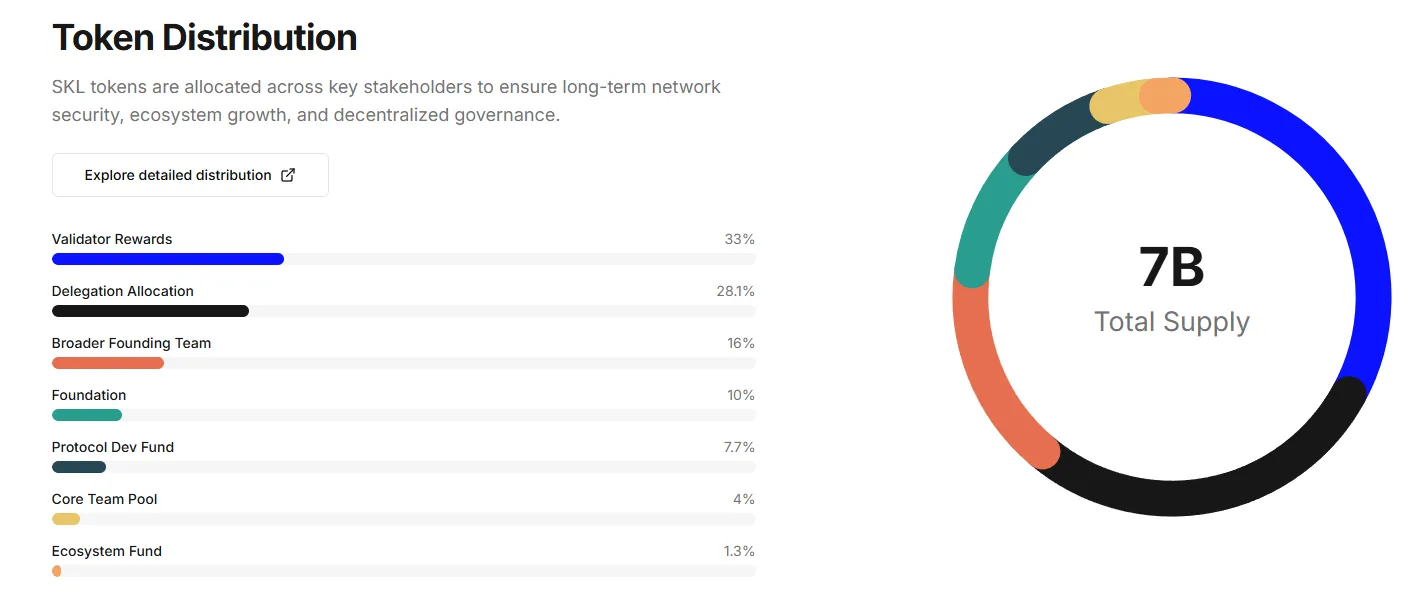
SKALE (SKL) Token Distribution, image source: SKALE
The token allocation is structured as follows:
- 33% allocated to validator rewards
- 28.1% allocated to delegators
- 16% allocated to the founding team, subject to vesting schedules of up to twelve years
- 10% allocated to the SKALE Foundation
- The remaining allocation covers investors and other ecosystem participants under similar long-term vesting structures
The long vesting schedules for the team and foundation are worth noting as a positive signal. They indicate that core insiders are not positioned to sell large amounts of tokens quickly, which reduces short-term selling pressure and aligns the team's incentives with the network's long-term health.
The Teams and Organizations Behind SKALE
SKALE is supported by two primary organizations. SKALE Labs handles core protocol development and contributes to the open-source codebase that powers the network. The N.O.D.E. Foundation supports public education, ecosystem growth, and community initiatives designed to expand awareness and adoption of the technology.
On-chain governance ensures that the broader community of SKL holders remains central to decisions about the network's future, rather than leaving those decisions entirely in the hands of the founding team or investors.
Why SKALE Matters in the Ethereum Ecosystem
SKALE crypto addresses one of the most persistent problems in the Ethereum ecosystem: the cost and congestion that make many applications impractical for everyday users. By offering dedicated chains, zero gas fees, and EVM compatibility, SKALE lowers the barrier to entry for both developers building applications and users interacting with them.
For anyone exploring the Layer-2 landscape or researching projects that are actively solving real usability problems in Web3, SKALE and the SKL token represent a technically grounded and practically motivated project worth understanding in depth.
